Decreased access to reproductive health care globally causing an increase in sexually transmitted diseases, unintended pregnancies, insufficient prenatal care, and unsafe abortion, especially in developing countries.
What is Health Policy?
Health policy is authoritative decisions made by any branch of government that direct or influence the lives of others (Longest, 2010). Often health policy in the US is thought of on the national level and not on the international level. However, decisions made about allocative health policy can have a huge impact on the international level.
The Problem
What truly is a problem to the government is greatly debated. It comes down to semantics what each political party believes. Additionally, a condition becomes a problem based on the values, comparisons, and categories placed on it (Kingdon, 2010). Often problems can fade and become less prominent in governmental minds and platforms. The health topic to be discussed here is one of the few problems that has been debated for a long time and is not leaving the political scene anytime soon, access to reproductive health care. However, this blog will focus on it with a new lens, a global lens.
Health Policy Topic
Decreased access to reproductive health care globally.
Why does this matter? It is causing an increase in sexually transmitted diseases, unintended pregnancies, insufficient prenatal care, and unsafe abortions, especially in developing countries.
Background
To understand the problem, one needs to understand the history behind the problem. Since the 1970’s there have been laws in the United States (US) regulating how US foreign assistance dollars can be used related to family planning and abortive services. After Roe v. Wade, Congress has passed amendments that restrict or dictate on how US foreign aid can be spent abroad on family planning or abortions (Blanchfield, 2019). Previously passed amendments include:
Helms Amendment (1973) stated:
“None of the funds made available to carry this part may be used to pay for the performance of abortions as a method of family planning or to motivate or coerce any person to practice abortions” (as cited in Blanchfield, 2019, p. 3)
DeConcini Amendment 1985
This amendment was introduced to counter policy put in place by President Reagan that previously had focused US aid to groups that focused on natural family planning like abstinence. It stated, “the United States would only fund family planning projects that offer a range of family planning methods and services, either directly or through referral” (Blanchfield, 2019, p. 5)
Kemp-Kasten Amendment 1985
This amendment states that money given by the US cannot be used towards any organization the President deems to support abortions or involuntary sterilization (Blanchfield, 2019). It was written under President Reagan due to concerns that the U.N. Population Fund’s (UNFPA’s) program in China was being used for abortions. Currently, under this amendment, President Trump is not giving money to UNFPA.
In addition to the Congressional amendments, the executive branch has historically signed two policies addressing abortion and family planning. The one to be discussed here was “The Mexico City Policy” also known as “Protecting Life in Global Health Assistance” (PLGHA) or more recently, in the media as the “The Global Gag Rule” (Blanchfield, 2019). The Mexico City Policy was first passed under President Reagan in 1984. This policy stated no US funds, received by nongovernmental organizations (NGOs) for family planning, could be used for abortive services or involuntary sterilization procedures; however, recipients of US foreign aid could use other money to engage in “abortion-related-activities” (Blanchfield, 2019, pp. 10) if the monies were in separate accounts. Organizations and groups that received USAID grant money were required to sign a contract that stated no US aid would be used perform or promote abortions as a family planning method.
As the presidency has changed between parties, the Mexico City Policy has been revoked and reinstated. Under President George W. Bush, the policy was reinstated but exceptions were put into place to allow abortions. These exceptions were “for cases of rape, incest, conditions that threatened the life of the mother, and for postabortion care” (Blanchfield, 2019, p. 11). He later added an additional exception for funds provided “through the President’s Emergency Plan for HIV/AIDS Relief (PEPFAR), and intergovernmental organizations, such as the United Nations and its affiliated entities” (Blanchfield, 2019, p. 11). The policy was then again revoked by President Obama in 2009.
In 2017, under President Trump, PLGHA was not only reinstated but expanded to all health organizations receiving US foreign aid. This expansion includes “programs addressing HIV/AIDS, maternal and child health, malaria, global health security, and family planning and reproductive health” (Blanchfield, 2019, p. 12). Therefore, if a health organization provided care outside of family planning but referred a patient to a place to receive abortion care, the organization could lose their US funds.
Impact on Developing Nations
Watch this video produced by Population Connection Fund on the Impact of the re-instatement of the Global Gag Rule in Nigeria.
Women all around the world are being impacted by policies being made by foreign countries. The goal of the PLGHA is to reduce the number of abortions occurring, instead, numbers of unsafe abortions are increasing due to an increase in the number of unintended (Brooks, Bendavid, & Miller, 2019). Instead of decreasing abortions, PLGHA is decreasing access to comprehensive sexual education and family planning that prevents pregnancy.
Current Legislation
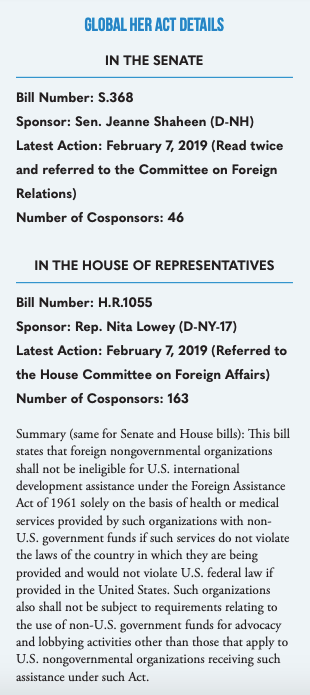
The newest legislation is the Global Health, Empowerment, and Rights Act (Global HER Act). This bill would repeal the Mexico City Policy and prevent future presidents from re-instating it. For more details, see image below from Population Connection, click for full document.
References
- Blanchfield, L. (2019). Abortion and Family Planning-Related Provisions in U.S. Foreign Assistance Law and Policy (CRS Report No. R41360). Retrieved from https://fas.org/sgp/crs/row/R41360.pdf
- Brooks, N., Bendavid, E., & Miller, G. (2019). USA aid policy and induced abortion in sub-Saharan Africa: an analysis of the Mexico City Policy. Lancet, 7(8), E1046-E1053.
- Kingdon, J.W. (2010). Agendas, Alternatives, and Public Policies, Update Edition (2nd ed.). London: Longman Publishing Group
- Longest, B.B. Jr. (2010). Health policymaking in the United States (5th ed.). Chicago, IL: Health Administration Press.
 Reproductive Care Globally: A Look at Policy
I was surprised to learn that United States (US) foreign aid for reproductive health care is mediated by US laws that restrict or grant the extent of reproductive health care that can be provided using the aid funds. Perhaps even more interesting is the connection between the existing US policy and China’s prior one-child policy. The Helms Amendment you listed precipitated a 1985 US withdrawal of a $10 million to the United Nations Fund for Population Activities (UNFPA). The US cited UNFPA participation in management of China’s family planning program, which it asserted used coercive abortion and involuntary sterilization to enforce the one-child policy (US Agency for International Development, Salas, & Laye, 1986).Citing the Kemp-Kasten amendment, Presidents Reagan, Bush, Bush, and Trump have withheld UNFPA funding for 19 out of the past 35 years (Kaiser Family Foundation, 2019). As you mentioned, the Kemp-Kasten amendment allows the president to limit funding to governmental, non-governmental, and multilateral organizations that support abortion or involuntary sterilization. Historically, the US has invoked the Kemp-Kasten amendment pnly in relation to China’s use of coercive abortion and involuntary sterilization (Kaiser Fmaily Foundation, 2019). Interestingly, despite widespread reports of coercive abortion and involuntary sterilization, including a 2011 US congressional hearing that outlined these violations against humanity, there have been multiple independent evaluations of UNFPA involvement in these activities that have found no evidence of UNFPA involvement in this category of family planning activities (Committee on Foreign Affairs, 2011; Kaiser Family Foundation, 2019). Given that China’s one-child policy ended in 2015 and UNFPA did not participate in China’s one-family policy, it is curious that the current administration continues to withdraw UNFPA funding.
References
Committee on Foreign Affairs. (2011). China’s one-child policy: The government’s massive crime against women and unborn babies (Serial No. 112-105). Washington, DC: U.S. Government Printing Office. Retrieved from https://congressional-proquest-com.ezproxy1.lib.asu.edu/congressional/result/pqpresultpage.gispdfhitspanel.pdflink/$2fapp-bin$2fgis-hearing$2f1$2fd$2fc$2f5$2fhrg-2011-foa-0094_from_1_to_81.pdf/entitlementkeys=1234%7Capp-gis%7Chearing%7Chrg-2011-foa-0094
Kaiser Family Foundation. UNFPA funding & kemp-kasten: An explainer. (2019). Retrieved from https://www.kff.org/global-health-policy/fact-sheet/unfpa-funding-kemp-kasten-an-explainer/
US Agency for International Development, Salas, R.M., & Laye, L. (1986). USAID/UNFPA discord over support for china’s family planning program. Population and Development Review, 12(1). doi: 10.2307/1973372
LikeLike