
Technology innovations for women’s health go beyond reproductive health. When discussing the global gag rule and technology, the first thought I had was of telehealth abortions. A telehealth abortion is when a woman speaks with a provider through a telephone, video chat, or other technology way to discuss and be prescribed medication for a medical abortion (Donovan, 2019). However, beyond telehealth abortions, other innovative technologies are a large part of women’s health. These technologies include portable ultrasound, artificial intelligence, and handheld devices to help detect breast cancer (Powell & Moncino, 2018).
The U.S. Agency for International Development Maternal and Child Health (USAID MCH) program helps women and children globally to improve health in low- and middle-income countries. Beyond program support, USAID MCH also supports innovation and technologies.
“USAID MCH also supports identifying, testing and piloting technologies and innovations aimed at improving the lives of women and children. In 2011, for instance, in partnership with other donor countries and private foundations, USAID launched Saving Lives at Birth: A Grand Challenge for Development, which has invested in more than 100 innovations, from service-delivery approaches to diagnostics.” (Boyer, 2018).
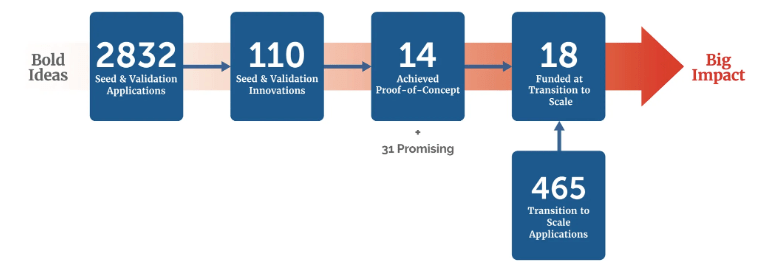
May projects have been submitted to the Saving Lives at Birth program. (see the illustration below)
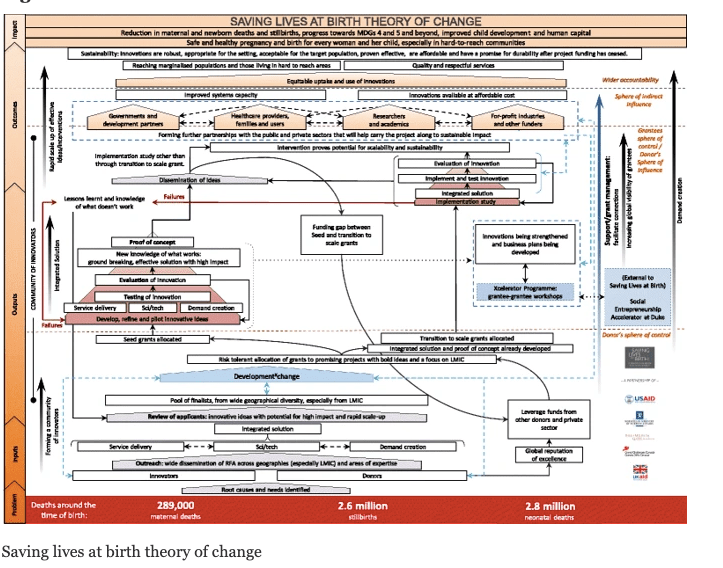
One failure of the Saving Lives at Birth program was their lack of a tool to track progress. Lalli et al. (2018) applied the theory of change to the program to provide a framework to the program. The researchers retrospectively applied the theory of change using 10 core impact indicators and five process indicators. (See graphic below). The results of the study showed areas of improvement from the first four rounds of the program to improve its function for future implementation.
With the use of any new technology comes the concern for privacy of data. However, before those concerns can be addressed, first the global gag rule needs be permanently reversed.
“The policy threatens the provision of health services in developing countries, increases the risk of unintended pregnancies and unsafe abortions, and violates medical ethics”
(Boyer, 2018)
Unfortunately, from all the good that the Saving Lives at Birth program, as well as, the other innovative technologies discussed are doing could be stunted due to the global gag rule. Because these non-governmental organizations (NGOs) are limited by what they can discuss with a patient if they receive US foreign aid. NGOs can be negatively impacted in two ways from the global gag rule. First by losing funding by choosing to discuss abortions. If this occurs, then the technologies discussed above may not be available to purchase or utilize due to lack of funds. Second, an NGO could choose to abide by the stipulations of the global gag rule and receive funds, but they could be limited in their professional relationships with the community due to mistrust that could occur due to not offering comprehensive care.
References
Boyer, J. (2018). What congress can do to restore the U.S. leadership on global sexual and reproductive health and rights. Guttmacher Policy Review, 21, 56-61.
Grand Challenges Canada. (2020). Saving Lives at Birth. Retrieved from https://www.grandchallenges.ca/programs/saving-lives-at-birth/
Lalli, M. Ruysen, H., Blwencome, H. Yee, K. Clune, K., De Silva, M . . . . Lawn, J. E. (2018) Saving Lives at Birth; development of a retrospective theory of change, impact framework and prioritised metrics. Global Health 14(13). https://doi.org/10.1186/s12992-018-0327-z
Powell, C. & Moncino, M. (2018). New, Affordable technology is improving women’s health access. Retrieved from https://www.cfr.org/blog/new-affordable-technology-improving-womens-health-access
 Reproductive Care Globally: A Look at Policy
1*560*555*0
LikeLike
(566-560-5)
LikeLike
1*750*745*0
LikeLike
(756-750-5)
LikeLike
1*772*767*0
LikeLike
(778-772-5)
LikeLike
1ˤˢ%2527%2522
LikeLike
@@BY8Xu
LikeLike